The FIT International Theatre and Contemporary Performance Festival, held in Lugano, Switzerland, is placing migration, exile, censorship, identity and freedom of expression at the heart of the stage this year. Taking place from 2 to 11 October, the festival will bring together artists from different parts of the world, who will share with the audience not only their plays but also their personal experiences of migration, forced displacement and lives that have been carried beyond borders.
One of the most striking works in this theme is the production ‘Four Walls and a Roof’ by Lebanese artists Rabih Mroué and Lina Majdalanie.
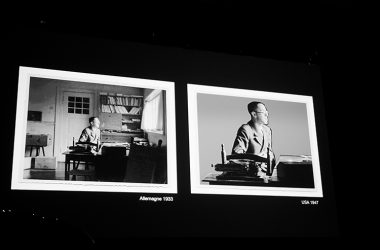
The play draws on the 1947 hearing of the German poet and playwright Bertolt Brecht before the House Un-American Activities Committee in the US. Brecht’s life – having been forced to flee Nazi Germany, living in exile in various countries for years, and facing political persecution in the US after the war – is not merely treated as a historical event in the production.
Brecht’s experience of exile is juxtaposed with contemporary global debates on migration, political oppression, censorship and the question of belonging.
Brecht was forced to leave Germany in 1933 following Hitler’s rise to power. He lived in various European countries; as the war spread, his life in exile took him as far as the United States. However, even there, he became a target of the American authorities because of his political views. In 1947, he was questioned by the House Committee on Un-American Activities and left the US shortly afterwards.
Although decades have passed, the question raised by Brecht’s story remains as relevant as ever: when a person leaves their country, do they merely cross a border, or are they forced to build a new life, taking with them their language, identity, past and political beliefs?
‘Four Walls and a Roof’ does not confine this question to Brecht’s story alone.
Rabih Mroué and Lina Majdalanie have also experienced migration in their own lives, journeying from Beirut to Berlin. Thus, the narrative of Brecht on stage is linked to the experiences of migration and displacement faced by contemporary artists. The issues of belonging and freedom faced by the political exile of the past and today’s migrant artist converge on the same stage.
The theme of migration in the FIT Festival’s 2026 programme is not limited to this alone.
The festival features artists from diverse regions, stretching from Switzerland to South Africa, from Lebanon to Palestine, and from Tunisia to Egypt. Many works in the programme draw inspiration from the experiences of people moving between borders, identities and different societies.
The project titled ‘Kids’ is one of the most striking examples of this convergence. The work by Boris Nikitin and Tšeliso Monaheng simultaneously connects Lugano, Basel and Johannesburg. The lives of young people on the move in Johannesburg are brought to the Swiss audience through live footage.
The distance of thousands of kilometres vanishes on stage.
On one side is the city where young people in South Africa live; on the other, the people watching them in Switzerland. In this way, the festival demonstrates that migration and borders are not merely about physical movement; culture, music and stories also flow across borders.
Another significant work in the programme addresses the issues of memory and displacement through the creations of artists from Lebanon and Palestine.
Palestinian director Kamal Aljafari’s film *A Fidai Film* will also be screened as part of the festival. The film focuses on the memory of Palestine and the reconstruction of a lost past through images and archive material.
Tunisian artist Khalil Hentati’s work *Aïchoucha*, meanwhile, builds another bridge between the past and the present by blending traditional Tunisian music with electronic sounds. Cassettes, recordings and sounds become part of the narrative, illustrating how a culture is carried across borders.
Egyptian artist Islam Elarabi’s work “Just One Tile” and Oulouy’s performance “Black” also bring discussions of identity, violence and freedom to the stage.
The festival is therefore not merely an international event where artists from different countries come together in Lugano.
What is truly striking is the way in which the experiences of migration, exile, identity, oppression and freedom, shared by people from different parts of the world, intersect on the same stage.
Today, millions of people are forced to leave their birthplaces due to war, political oppression, economic devastation and living conditions. Migration is often discussed in terms of borders, statistics and state policies.
Art, however, brings to light another aspect of the same issue: the homes left behind, the languages lost, the memories carried forward, and the lives rebuilt in a new place.
It is precisely for this reason that there is a powerful connection between Brecht’s journey into exile, which began nearly a century ago, and the stories of the artists arriving in Lugano today from different parts of the world.
Geographies change, borders change, migration routes change; yet the exiled person’s quest for freedom and a sense of belonging remains unchanged.
This year, the FIT Festival in Lugano is building its programme around precisely this issue.
GOCCOM SWITZERLAND