


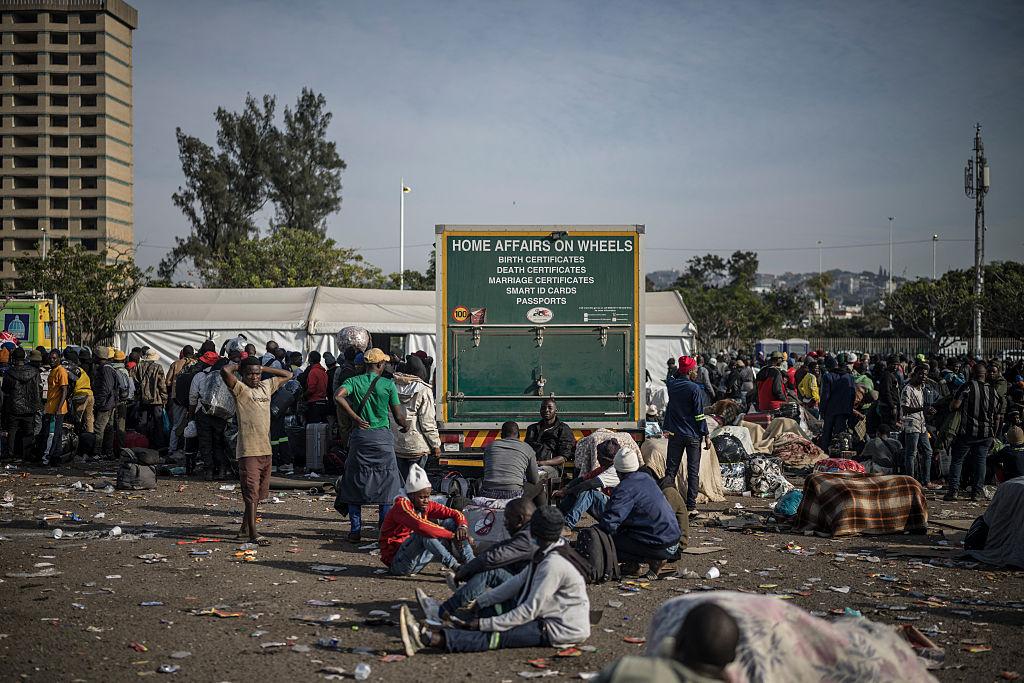
In the South African city of Durban, hundreds of refugees and asylum-seekers are fearing further attacks as 30 September approaches – the deadline set by the anti-immigration ‘March and March’ movement for undocumented migrants to leave the country. The call, which has no legal binding force, has heightened security concerns within refugee communities due to the anti-foreigner attacks and threats that have taken place in recent months.
At the centre of the tension in Durban are refugees and asylum-seekers from the Democratic Republic of the Congo, Burundi, Uganda, Mozambique and other African countries. Hundreds of people, including women and children, who had left their neighbourhoods out of fear of anti-foreigner attacks, lived temporarily for months around the Ministry of Home Affairs building in Durban.
The tensions turned violent on 3 September. It was reported that at least four people were injured in clashes between members of the anti-immigration group and refugees and asylum-seekers in the area.
The ‘March and March’ campaign maintains that it targets undocumented migration, crime and the government’s migration policy, rather than foreigners, and rejects accusations of xenophobia. Refugees, however, point out that the crackdown is not limited to undocumented individuals, but that foreigners with legal status can also be targeted.
The South African government cleared the temporary settlement in Durban in mid-September. Refugees and asylum-seekers were given the choice of returning to the areas where they had previously lived or going to the Lindela Deportation Centre in the Gauteng province, hundreds of kilometres away from Durban.
On 15 September, 274 people were transferred to Lindela. According to government figures, 191 of them were citizens of the Democratic Republic of the Congo, 76 from Burundi, five from Uganda, one from Mozambique and one from Ghana. Around 150 people chose to remain in Durban.
The clearance of the temporary settlement did not resolve the security issue. Some of the refugees who have not returned to their home areas report that they fear being attacked again. There are also those who have lost their jobs and livelihoods as a result of months of displacement.
Violence against foreign nationals has long been a significant social issue in South Africa. In 2008, anti-foreigner attacks spread across various regions of the country, resulting in the deaths of dozens of people and the displacement of thousands. Attacks targeting migrants have also occurred in subsequent years.
Economic hardship, high unemployment, crime and problems with public services have recently returned to the centre of the migration debate. Against this backdrop, rhetoric blaming refugees and migrants for economic and social problems is gaining ground.
According to data from the United Nations High Commissioner for Refugees, South Africa was hosting more than 167,000 refugees and asylum-seekers in 2025. As there is no general system of refugee camps in the country, the vast majority of refugees live in towns and cities alongside local communities.
One of the key points of the debate in Durban is who has the authority to decide on the removal of migrants from the country. The South African government states that the authority to enforce immigration laws and carry out deportations lies with the state, and that no private individuals or groups have the authority to remove foreigners from the country.
Consequently, the 30 September deadline announced by March and March is not an official deportation deadline. However, as the date approaches, concerns are growing amongst refugees and asylum-seekers – who have previously faced attacks and threats – that further incidents of violence may occur.
For those remaining in Durban, the problem remains unresolved: secure accommodation, access to livelihoods and a safe return to the areas they previously left remain uncertain.
Goccom