


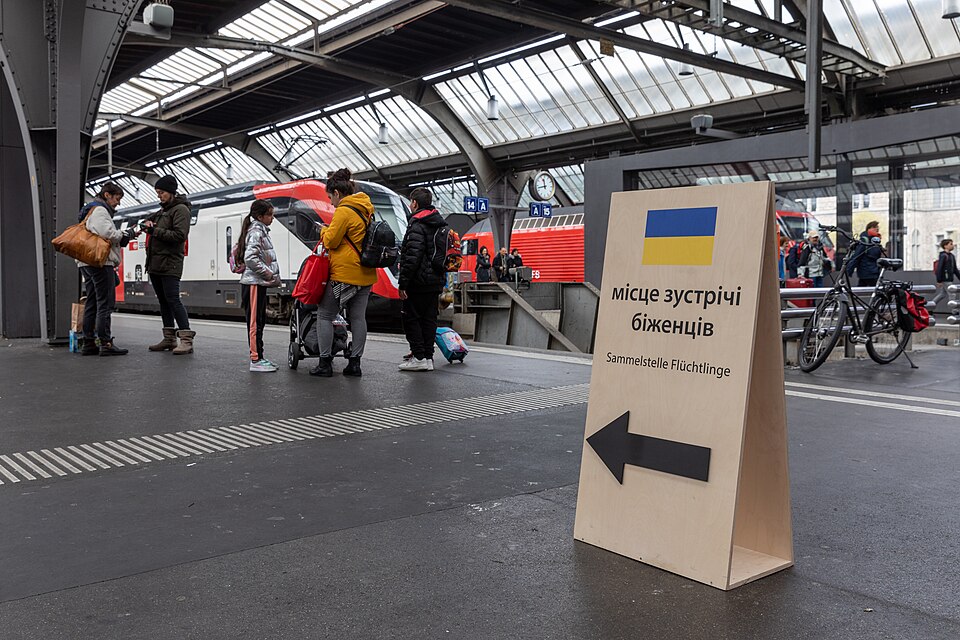
In Switzerland, a new regulation designed to make it easier for people from Ukraine with temporary protection status to access the labour market has cleared a major parliamentary hurdle. The National Council approved the amendment proposed by the Federal Council by 128 votes to 65.
The Council of States must now consider the bill. The planned changes have therefore not yet come into force.
A key aspect of the new regulation concerns the change of canton for people with protection status S who live and work in Switzerland.
Under the current system, people with S protection status are assigned to a specific canton upon their arrival in Switzerland. Whilst they may work in another canton, changing their canton of residence is not always straightforward.
Under the new regulations, individuals with S protection status will, subject to certain conditions, be able to change cantons provided they are not dependent on social assistance and have been in employment for at least twelve months. It should also be possible to take into account very long commutes or working hours that make commuting from their current place of residence considerably more difficult.
People with S protection status are already permitted to work in Switzerland. The new rules therefore do not create a new right to work. Rather, they are intended to facilitate integration into the labour market and enable employees to better align their place of residence with their place of work.
What does ‘S’ protection status mean?
Protection status S is a form of temporary protection for people who are forced to leave their country in large numbers due to war or a comparable serious threat.
Switzerland first activated this status on a large scale in 2022 for people who fled the country following the Russian attack on Ukraine.
People with protection status S are granted temporary protection in Switzerland without first having to go through a lengthy individual asylum procedure. They are permitted to work, have access to education and healthcare, and may receive social assistance under certain conditions.
In view of the continuing unstable situation in Ukraine, the Swiss Government has decided not to lift protection status S generally before 4 March 2028.
The federal government has been working for several years to increase the participation of people with S protection status in the labour market. One aim is to promote the economic independence of those capable of working and to reduce their dependence on social assistance.
The amendment to the law adopted by the National Council does not only affect people with S protection status. Access to the labour market is also to be made easier for certain third-country nationals who have completed a course of education in Switzerland.
Among others, this is intended to benefit people who have completed higher vocational training in Switzerland or who carry out certain academic activities and whose work is of particular scientific or economic significance.
If the Council of States also approves the bill and the parliamentary process is concluded, existing barriers between place of residence and place of work could be reduced, particularly for Ukrainians who have been living and working in Switzerland for several years.
At this stage, however, these are not yet new rights that have come into force. The legislative amendment is still going through the parliamentary process.
GOCCOM SWITZERLAND