


GOCCOM · Türkçe | Deutsch | Français | Italiano | English
2 November 2026 | Fundamental and human rights, peace policy, international solidarity
Watch him speak here of a turning point in history.
It is socialism he promises you.
But behind him, see the work of your hands:
Great cannons, silently trained upon you.Bertolt Brecht, War Primer (Kriegsfibel), 1955
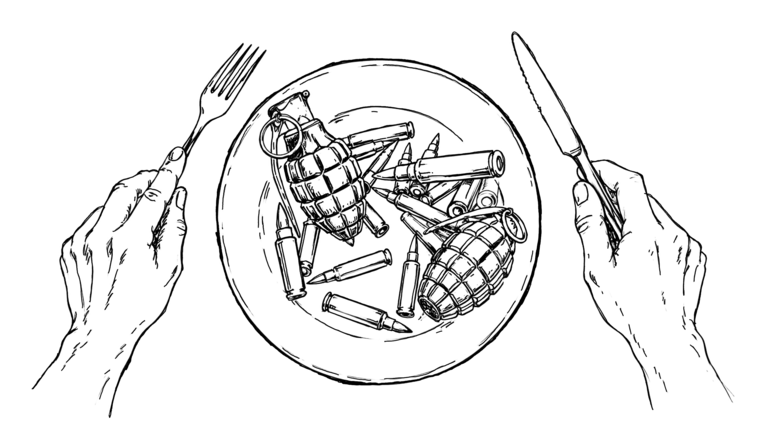
Europe is rearming, and Switzerland is joining in. This November we are already voting on expanding exports of war materiel (see article on page 2), while the Council of States has debated how to make an enormous rearmament package possible.
A debt-financed fund of 24 billion Swiss francs is to be created as early as 2027. What is particularly brazen is that the fund is initially planned without any counter-financing. Later the population will be presented with a fait accompli. The choice will then be: higher value-added tax or a new austerity package targeting essential public services. December will reveal the position of the National Council.
The debate already shows how one-dimensional the discussion of security has become. Financing “national security” always comes at the expense of “social security”. In Germany, cuts to social spending are already being felt. The real blow will come when interest payments on the debt fall due, according to calculations by Dierk Hirschl, chief economist of the German trade union ver.di. Here too, weapons are being paid for with debt. As Ingar Solty puts it: “Quite possibly some of the population will then realise that the housing problem and the childcare crisis cannot be solved by having us all live in tanks and dropping our toddlers off at the barracks in the morning.”
What is new in Germany is that the ideology of rearmament is also taking hold among the population. Solty calls this an “internal turning point”. Ostensibly, the rearmament debate is about defensive military expansion. Russia’s war of aggression against Ukraine, systematic violations of international law and Putin’s repeated nuclear threats have created a real, not merely manufactured, need for security in Europe. Less officially, but clearly, the EU is also pursuing proactive rearmament as a new geopolitical “power project [of a] German-dominated EU alongside or independently of the United States” (Solty).
The decisive question is therefore not merely how much Europe is rearming, but what rearmament does to society. Today it is presented as the seemingly inevitable response to an insecure world. Yet it is not simply a reaction to external threats. It changes political priorities, ties up enormous public and private resources, and shifts our ideas of what security means. Militarisation thereby becomes a social project in its own right.
Despite its neutrality, Switzerland is deeply integrated into Europe geographically and economically. To answer the question of the pre-war period in Switzerland, we must also examine the dynamics within the EU and NATO.
Who is driving the rearmament spiral?
NATO’s previous spending target of two per cent of GDP was replaced in 2025 by a new target of five per cent by 2035. This encompasses not only traditional military spending but also defence-related infrastructure. The target was pushed particularly aggressively under Donald Trump. At the same time, the five largest arms companies in the world are based in the United States (see Solty). Rearmament is therefore not only security policy but also a form of military Keynesian economic stimulus that makes dividends soar.
Switzerland is also considering such a debt-financed arms fund. Meanwhile, millions are already invested through our pension funds. The WAV research group revealed that at least eight Swiss pension funds hold stakes in arms companies worth 638 million francs. These include companies developing nuclear weapons and cluster munitions, whose financing is in principle prohibited by the War Materiel Act. The relaxation of that law, on which we are voting in November, would further fuel European rearmament. The main beneficiary would be Germany’s Rheinmetall. In 2025, the State Secretariat for Economic Affairs (SECO) approved war materiel exports worth 2.77 billion Swiss francs. Seventy-one per cent of that value went to three Rheinmetall subsidiaries and joint ventures. Rearmament has long been a Swiss business too.
But foreign policy involves more than the arms industry. Europe’s foreign policy consensus combines economic interests with geopolitical power projection. Solty identifies two ideal-typical tendencies in the foreign-policy establishment: “On one side are the Atlanticists, who pursue global power projection as privileged partners of the US […]; on the other are the German-European geopoliticians, who seek military capacity to act independently of the US (and NATO).”
How Switzerland, a small military but significant economic player, will position itself in this field of tension remains unclear. But it can be expected that these strategic foreign-policy decisions will be made on the basis of economic interests.
As socialists, we should not enter this minefield. The question must not be with whom we will rearm and become “war-ready”, but how we can restore the capacity for peace. “To be capable of war means to possess the willingness and ability to endanger other people’s lives and livelihoods, as well as one’s own,” writes Maja Apelt. How, then, can we prevent killing organised hierarchically through a division of labour?
Apelt identifies three fields of intervention in militarisation:
Material militarisation: The immense allocation of economic resources to rearmament. Arms companies benefit while money is lacking for other tasks, such as education and social provision.
Ideological militarisation: This concerns the moral, ideological and psychological rearmament of the population. Defence is to become part of everyday thinking. This field is also linked to psychological and bodily armouring, the glorification of particular forms of masculinity, and the confinement of women to childbearing. One example is the French state campaign to encourage births, launched under the slogan “demographic rearmament”. A militarised society needs children and a public willing to accept young people’s lives being sacrificed in war as part of a “necessary defence”.
Institutional militarisation: The army itself is to be strengthened through massive investment in technical and technological equipment and intensified recruitment. Switzerland has its own version of this development in the tightening of civilian service rules and the referendum narrowly lost on 14 June 2026.
But when does the pre-war period begin?
The public discourse on rearmament presents it as unavoidable. “If you want peace, prepare for war” is the watchword. By this logic, arms manufacturers would be the world’s most effective peace activists, Ingar Solty writes sarcastically. Yet violence needs legitimacy, particularly when organised by liberal democracies. I painfully remember the justification of the invasion of Afghanistan as the liberation of Afghan women. Those were the very women whose protection is once again being called into question today, although they are expected to live under precisely the regime from which military intervention once promised to free them. We must therefore firmly resist this normalisation of war as an instrument of politics, even when it comes wrapped in a liberal promise to protect women.
In Cassandra, Christa Wolf has her protagonist ask questions that invite action: “When did the state of war into which we are increasingly being pushed actually begin? And how did we reach the point where, supposedly, there is no going back?” (see Brunner). Wolf introduces the concept of the pre-war period, whose rules must be spoken aloud, written down and passed on. “Among other sentences, it would say: Do not let your own side deceive you.” (Wolf)
One such deception is making militarisation appear modern, inclusive and even emancipatory. Greater participation by women in military institutions does not change those institutions’ logic of violence. Instead, it may help give militarisation renewed social legitimacy.
Another deception is the claim that deterrence, rearmament and nuclear weapons have no alternative. According to Brunner, the “European peace project” is thus to be transformed into a defence union. This is not only about accepting militarisation as the lesser evil of realpolitik, but about shifting our inner attitudes towards an immaterial general mobilisation. What we feel, think and internalise precedes the violence of war and outlasts it.
Switzerland cannot simply evade these realignments. But that does not necessarily mean joining Europe’s rearmament spiral.
We therefore need a counter-narrative. A feminist foreign policy alone is not enough unless it also questions militarisation and the social conditions that sustain it. Feminism must also mean asking what forms of security we actually want to create. Our task is to develop a security project that genuinely brings together social, ecological and civilian security.
War does not begin only when weapons are used. It arises from economic interests, geopolitical power relations, nationalist narratives and patriarchal assumptions about who should protect and who should be protected. We must not limit ourselves to denouncing the excesses of particular wars. We must recognise the connections among militarism, nationalism, colonialism, imperialism, capitalism and patriarchy — and name those who benefit from them.
That also means thinking and speaking about security not primarily in national terms, but from below. A society is secure only when people have homes, when care work can be performed, when healthcare is accessible and when the foundations of life are preserved. This is true internationally, not only in Switzerland. Free-trade agreements presented as purely economic matters therefore affect the capacity for peace just as military cooperation does. Political decisions on the 24-billion-franc rearmament package and the upcoming vote on the War Materiel Act are questions of class. The Swiss arms lobby also wants its share of the global militarisation pie. We pay for it through the erosion of social security, setbacks in feminist struggles and the emotional armouring that prepares us inwardly for war. We should not be surprised when authoritarian and fascist forces grow in such soil.
The pre-war period began a long time ago.
Franziska Stier, Party Secretary, BastA!
Sources and literature
Jutta Weber: https://www.zeitschrift-luxemburg.de/artikel/wider-den-vorkrieg
Ingar Solty: https://www.zeitschrift-luxemburg.de/artikel/die-ideologie-der-inneren-zeitenwende
Maja Apelt: https://www.zeitschrift-luxemburg.de/artikel/das-geschlecht-der-kriegstuechtigkeit
Jan Jirat: https://www.woz.ch/2640/ruestungsreport-2026/lex-rheinmetall/!GPT99DHJ3XJK
https://www.saldo.ch/artikel/artikeldetail/pensionskassen-investieren-viel-gel-in-ruestungskonzerne
https://wav.info/recherchen/wav-daten-ermoeglichen-ruestungsrecherchen