


Seyhan Uludag
On 1 November 2024, the concrete canopy of the recently renovated railway station in Novi Sad, Serbia, collapsed. Fourteen people died at the scene, and two seriously injured people died later. Sixteen deaths raised clear questions: Who carried out the renovation? Who supervised the construction? How was public money spent? Why were those responsible not held accountable?
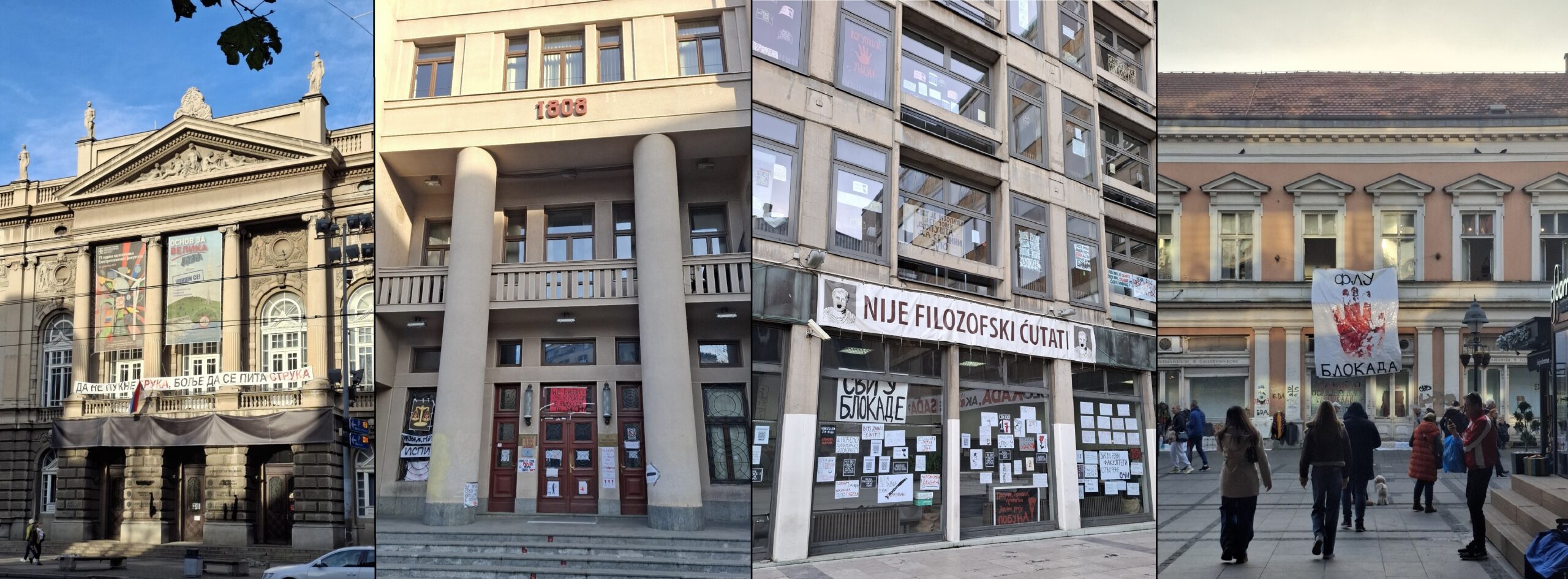
Aleksandar Vučić’s government could not suppress the resulting anger. University classes were boycotted, faculties occupied and marches organised between cities. Despite police interventions, attacks and political pressure, the students refused to retreat. Workers, teachers, farmers and different social groups joined their struggle.
For two years, the students did more than protest. They made decisions in university assemblies, created their own organisations and built a political alternative independent of traditional opposition parties.
According to the announced results of the 25 October 2026 election, the Student List won 52.65 percent of the vote and Vučić’s alliance 39.22 percent. The political bloc that had dominated the country for years suffered electoral defeat in the face of the organised struggle initiated by the students.
Serbia’s students did not simply wait for a change in power. They organised the social force capable of bringing it about.
But the historical significance is not confined to which party won how many seats. By rejecting the notion that politics was a privilege shared by government and traditional opposition, students raised a fundamental question: Why must society continually delegate the right to decide its own fate to someone else?
The movement against the government expanded from university boycotts into mass demonstrations. Workers, teachers, farmers and different social groups met in the space of struggle opened by the students.
Yet its historical significance was not simply the breadth of social support.
In university assemblies, students began making decisions together. Through debate, disagreements and the search for common decisions, they forged a political will outside professional party politics.
The experience exposed a central contradiction of our times: Why is the people excluded from decisions determining their own lives in political systems supposedly founded on popular sovereignty?
In parliamentary democracy, society’s political role is often reduced to the right to vote. After elections, governing power passes to representatives while capital retains decisive influence over the economy, property and production.
People can therefore be legally equal citizens without having equal power to shape social life.
The organising methods of Serbian students intervened in the political side of this contradiction.
They showed that the right to decide does not belong exclusively to elected representatives and that society can form its own organised collective will.
This has precedents. From the Paris Commune to workers’ councils, different historical experiences of direct democracy emerged from attempts to overcome the separation between representatives and those they represent.
It would nevertheless be wrong to equate Serbia’s student assemblies with those experiments. Their class content and historical circumstances differ. Yet they raise the same fundamental question: Will political power be concentrated in a ruling stratum detached from society, or will society become an organised force able to govern its own life?
This is the deeper significance of the Serbian experience.
Rather than joining the traditional opposition, students created their own political alternative. Their choice expressed not only opposition to the government, but also mistrust of existing forms of political representation.
One of the clearest examples of this political intervention was the way parliamentary candidates were selected.
In conventional political parties, candidate lists are generally determined through processes dominated by leaders, party executives and political power centres. Serbia’s students instead brought candidate selection into university assemblies. Names proposed by faculties were debated, and the views of universities assessed nationally.
The resulting list of 250 candidates prioritised people who had not previously held senior political office. Academics, doctors, artists, activists and athletes were among those chosen.
The importance of that choice goes beyond recruiting people who are not career politicians.
The essential distinction is between the right to stand as a candidate and the power to choose who stands.
Rather than creating a new political elite from within their own ranks, students attempted to appoint representatives from different parts of society. They suggested that politics could be a public responsibility organised and supervised by society, not merely a route to office.
Yet there is a contradiction here too. Whether a movement that collectively chooses its representatives can retain the same power to hold them accountable after they enter parliament is not yet known.
Letting people choose candidates is an important democratic step. But preventing elected representatives from becoming a new political power independent of the public requires lasting structures of organisation and oversight.
Discontent with the existing political class must not automatically be understood as a break with class relations.
Students do not constitute a social class. They come from different economic and ideological backgrounds and have come together in a common struggle. The coexistence of progressive, conservative and nationalist currents does not change that fact.
People united against government corruption do not necessarily share the same views about ownership of the means of production, wage policies or capital’s social power.
The democratic character of a movement and its class character are not the same thing.
That distinction matters because corruption is not the only source of inequality under capitalism.
Even if every public contract were completely transparent and no official enjoyed privileges, private ownership of the means of production and wage labour could continue.
The end of corruption does not mean the end of exploitation.
The students’ electoral victory is therefore a democratic achievement, but it does not signify that social property relations have already been transformed.
The movement’s solidarity across national and cultural boundaries also deserves attention. The participation of Bosniak young people in protests matters in view of the Balkans’ painful historical legacy.
When communities divided by nationalism unite around shared democratic demands, social struggles can also challenge national prejudices.
Whether that solidarity endures will depend on how the equal rights of different peoples and their historical grievances are handled politically.
Serbia is also a crossroads of international power struggles. Competition among the European Union, the United States, Russia and China strongly influences the country’s economic and diplomatic relations.
To reduce every mass popular movement to foreign interference simply because imperialist interventions have historically occurred is to make social contradictions invisible.
Relations with foreign capital must also be examined through the economic decisions of existing rulers, not only those of the opposition.
The plan to open the site of Belgrade’s former General Staff building, damaged during NATO bombing, to a luxury investment project linked to Jared Kushner’s company is one example.
It exposes the tension between the rhetoric of national sovereignty and the interests of international capital.
A country’s independence concerns more than its flag and borders. It also concerns who controls its land, public assets and social wealth.
After the Serbian elections, all these contradictions enter a new political period.
The broad social coalition formed around the students will be tested by economic decisions taken in government. On wages, privatisation, public services and foreign investments, different interests within the movement may come to the surface.
It is precisely here that the future of the students’ organising experience becomes important.
Can the collective will born in universities and streets remain independent after it enters parliament? Or will electoral victory lead it to transfer its own political power to representatives and reproduce the old relationships?
Political oligarchy is not merely the lengthy rule of certain individuals. It is society’s exclusion from decision-making and the transformation of politics into the preserve of a privileged governing circle.
A transfer of government therefore does not in itself prove the end of political oligarchy.
That is why I do not see the students’ success in Serbia as merely an election victory.
They defeated a power regarded as unchangeable while demonstrating that society can organise its own political strength.
There is no need to romanticise this historical experience. A social revolution has not yet taken place in Serbia. But an important struggle showed that political change need not be confined to choosing among existing parties.
Other countries have reason to reflect on this.
Change may arise not from waiting for a new saviour but from people creating their own organisation and political will.
Yet its true measure is not just votes won, but how much power working people gain over production and government.
Serbian students overthrew a political bloc. Their historical test now is whether they can build not only new leaders but new social relationships in which society has more say over its future.
The collapse of a concrete canopy at a railway station became the beginning of a movement demanding accountability from the state.
That movement now shapes the direction of government.
What happens next will depend on whether the path opened by students leads to a new political elite or a social transformation that expands the organised power of the people.