


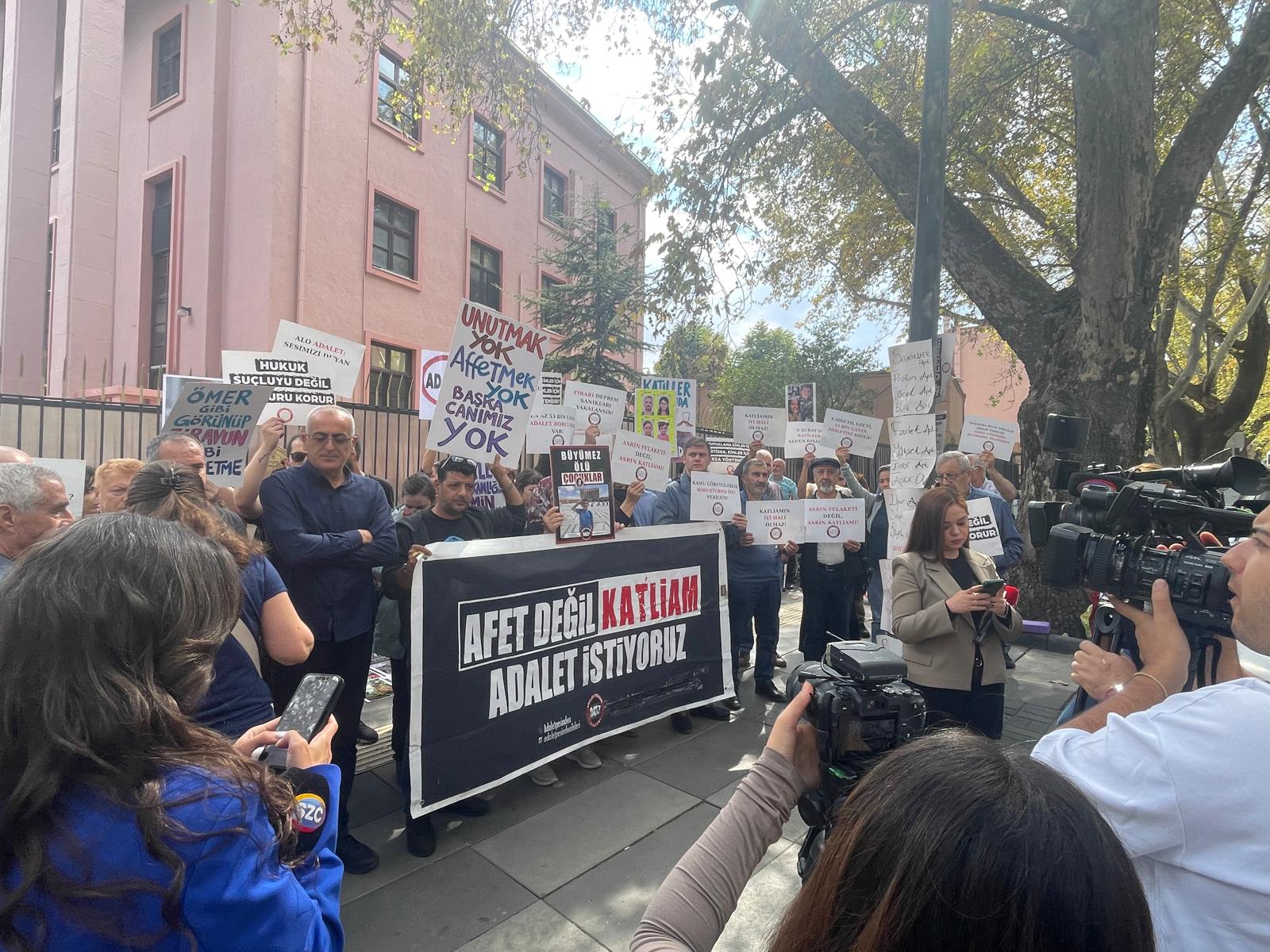
PRESS RELEASE
FROM THE ‘FAMILIES IN PURSUIT OF JUSTICE’ PLATFORM
20 September 2026
Dear members of the press,
It has been 1,322 days – four judicial years – since the 6 February earthquakes, which we have termed the ‘Massacre of the Century’. Despite this, justice has still not been served.
The new judicial year began on 1 September. We, however, are still owed justice from previous judicial years.
The rule of law requires that no one be held above the law by virtue of their position, title or influence, and that everyone be equal before the law. Justice must be administered without delay, without discrimination and free from the influence of any authority. Judicial independence must be realised not merely on paper, but in every investigation, every case file and every judgement.
The problem we are now facing, at the end of four judicial years, is no longer merely a matter of delays in individual case files. We are confronted with a structural accountability issue that extends from investigations to expert witness proceedings, and from the accountability of public officials to the rules of criminal procedure.
THERE ARE
STILL CASES WHERE INDICTMENTS HAVE NOT YET BEEN DRAWN UP In dozens of cases, including those involving the Rana Block of Flats, where 35 people lost their lives, and the Arı Block of Flats, where 31 people lost their lives, indictments have still not been drawn up.
It is unacceptable that, more than three and a half years on, investigations into these fatal collapses remain incomplete. Evidence must be gathered, those responsible identified, and investigations concluded within a reasonable timeframe.
Cases currently at the investigation stage must not be delayed any further; where there is sufficient suspicion, indictments must be drawn up without delay.
CRIMINAL JUSTICE MUST
BE APPLIED FAIRLY AND CONSISTENTLY In the Ebrar Sitesi Block G case in Kahramanmaraş, where we lost 124 lives, whilst the contractor was sentenced to 17 years and 4 months’ imprisonment, the eight-year sentences handed down to the then Director of Town Planning and his deputy, who were also on trial in the same case, were reduced to 6 years and 8 months each following the application of a ‘good behaviour discount’.
In the Penta Park Site case, a ‘good behaviour discount’ was applied to a contractor who was caught attempting to flee abroad by boat.
Discretionary reductions should not become an automatic procedure; they must be assessed in a concrete, verifiable and reasoned manner in each individual case. Justice requires the equal and consistent application of criminal law to all.
FUGITIVE DEFENDANTS MUST
BE APPREHENDED Despite a red notice being issued for the contractor in the Üzümkent Site case, in which we lost 83 lives in Adıyaman, he has remained at large for months. In the Palmiye Sitesi case in Kahramanmaraş, where 152 lives were lost, the contractor who received a prison sentence has been on the run for a long time.
Locating defendants subject to arrest warrants and bringing them before the courts is essential for an effective criminal trial. All effective measures to apprehend the fugitive defendants must be taken without delay.
THE CONSEQUENCES OF THE ‘URBAN PLANNING AMNESTY’ MUST ALSO BE INVESTIGATED
It has emerged that the Trend Garden Residence in Malatya, where 31 lives were lost, was expanded from 12 flats to 42 under the ‘Urban Planning Amnesty’.
In this and similar cases, it is not only those responsible for the building’s final condition who must be investigated, but also the administrative and legal processes that made the alterations affecting the structure’s safety possible.
The impact of the ‘Urban Planning Peace’ regulations on buildings that collapsed in the earthquake, and the role of the individuals and institutions bearing responsibility in these processes, must be thoroughly investigated.
THE NATURE OF THE OFFENCE MUST
BE DETERMINED ON THE BASIS OF EVIDENCE In the case of the Alpargün Block of Flats in Adana, where we lost 96 lives, the local court handed down 62 life sentences and a total of 865 years’ imprisonment for the offence of “manslaughter with probable intent”. The ruling has been referred for judicial review.
Determining the nature of the offence in earthquake cases is one of the most crucial issues in the pursuit of justice. Our demand is not that all cases be automatically assessed under the same legal classification. If the evidence in a specific case demonstrates that the defendant was aware of the risks posed by the building and nevertheless continued with their actions, the possibility of intent must be effectively investigated; cases must not be automatically limited to the charge of wilful negligence.
When making this assessment, the fact that the same defendant may be on trial in other earthquake-related cases should not be overlooked. We observe that some defendants are being tried in connection with the collapse of numerous separate buildings.
Being a defendant in more than one case does not, in itself, indicate guilt or a more serious offence. However, it must be investigated whether similar acts and omissions have recurred in different buildings, whether the defendant was aware of the risks, and whether they nevertheless continued with the same pattern of behaviour.
Recurring practices are significant in determining the defendant’s level of knowledge, foresight and degree of fault. In cases where the same defendant is on trial in more than one earthquake-related case, the links between the cases and the recurring acts and omissions must be taken into account when determining the nature of the offence.
LIABILITY IS
NOT LIMITED TO CONTRACTORS ALONE One of the fundamental issues in the investigations and prosecutions conducted following the 6 February earthquakes is that the entire chain of responsibility has not been sufficiently examined.
The construction and continued use of a building do not consist solely of the contractor’s actions. Various individuals and public bodies have duties and responsibilities in the processes of design, licensing, building inspection, granting of occupation permits, alterations, risk assessment and, where necessary, reinforcement.
An effective investigation must encompass not only those who built the structure, but the entire chain of oversight and decision-making responsible for the building’s safety.
THE LIABILITY OF PUBLIC OFFICIALS MUST
BE INVESTIGATED In the expert report concerning the Arıkan Site in Maraş, it was noted that AFAD’s risk reduction plan had identified the risks pertaining to the area where the building was situated, and the responsibility of public institutions was discussed.
If expert reports contain findings regarding the negligence or liability of public officials, these must form the subject of an effective investigation. The mechanism for granting permission to investigate public officials must not become a protective shield that delays or effectively obstructs the investigation.
At the Osmaniye Bilge Housing Estate, we lost 105 lives, 27 of whom were babies and children. The publication of a photograph showing the president of the court that ordered the release of the former mayor, who had been sentenced to imprisonment, alongside the mayor himself, has raised questions regarding the impartiality of the judiciary. This matter must be clarified in a manner that leaves no room for doubt.
ACCOUNTABILITY MUST
ALSO BE SEEKED FOR DEATHS IN PUBLIC BUILDINGS In the 6 February earthquakes, hospitals, schools, student halls of residence and other public service buildings were also destroyed.
Public buildings are not ordinary structures. The safety of a hospital is directly linked to patients’ right to life; the safety of a school is linked to children’s right to life and education; and the safety of a student hall of residence is linked to the state’s duty of care.
Article 17 of the Constitution guarantees the right to life. The failure to take the necessary inspection, maintenance and reinforcement measures, despite the known risks in public buildings, cannot be viewed merely as a technical or administrative shortcoming; it must also be investigated in terms of the state’s duty to protect life.
Hatay is one of the most severe examples of this. According to our research, three state-run and two private hospitals in Hatay, where fatalities occurred, have collapsed.
At the Iskenderun State Hospital, where we lost 125 lives, an indictment has still not been drawn up. Meanwhile, at the Hatay Training and Research Hospital Annex, where 68 lives were lost, no authorisation has been granted to launch an investigation into the former chief physicians and provincial health directors.
Responsibility for the collapse of public service buildings resulting in such a high loss of life cannot be attributed to a single individual. The actions and omissions of those responsible for the safety of the structure, the identification of risks, decisions regarding maintenance and reinforcement, and the continued use of the building must be investigated.
In the case of a girls’ student hall of residence where we lost 13 lives, the fact that the building had previously been assessed as ‘earthquake-resistant’ was used as grounds for the acquittal of the engineer who prepared the report at the court of first instance; however, the Court of Cassation overturned this acquittal.
This example demonstrates once again that every individual involved in determining, approving and authorising the safe use of a building is part of the chain of oversight and responsibility.
PROCEDURAL ERRORS SHOULD
NOT DELAY JUSTICE The problem in earthquake cases is not merely the delay in investigations. Procedural errors committed during the trial also lead to some cases being reheard years later.
In a case where we lost 69 lives, the Regional Court of Appeal’s decision—which was issued without holding a hearing, without investigating objections regarding the signatures on the expert report, and without providing sufficient grounds—was overturned by the Court of Cassation; the case, which has been ongoing for over three and a half years, has had to be retried.
In another case in Kahramanmaraş, the case has reached the stage of being retried due to legal irregularities in the appeal court’s decision to quash the judgement.
Justice is not merely a verdict that has been handed down. It requires that the entire process, from the start of the investigation to the final judgement, be conducted in accordance with the law. Families who have been waiting for years in the corridors of the courts should not have to pay the price for procedural errors.
WE HAVE
FIVE URGENT DEMANDS FOR THE NEW JUDICIAL YEAR In our struggle for justice, which has now lasted for over three and a half years, we will not allow the chain of negligence to be swept under the carpet.
Our call to the competent authorities and judicial bodies is clear:
- Effective and timely investigations:
Pending investigations must be completed, evidence must be gathered without delay, and indictments must be drawn up in cases where there is reasonable suspicion. - Investigation of the entire chain of responsibility:
Investigations must not be limited to contractors; the actions and omissions of all individuals and public officials bearing responsibility in the processes of project design, licensing, building inspection, occupancy permits, risk assessment and structural reinforcement must be investigated. The processes for obtaining investigation authorisation must not act as a barrier to effective investigations. - Independent, impartial and scientific expert assessment:
Expert reports must be based on scientific data, be verifiable and cover the entire chain of responsibility. Decisions must not be taken until conflicting reports have been resolved. - Determination of the nature of the offence based on an evaluation of all evidence:
In cases where elements of possible intent are present, this possibility must be effectively investigated; where the same defendant is on trial in more than one earthquake-related case, the connections between the cases, as well as any repeated acts and omissions, must also be assessed. - Trials within a reasonable timeframe and in accordance with due process:
Effective measures must be taken to apprehend fugitive defendants; the practice of cases dragging on for years due to missing documents, delays by expert witnesses and procedural errors must be brought to an end. Judgements must be reasoned, verifiable and in accordance with the law.
Four judicial years have passed.
We no longer seek merely the punishment of individual defendants, but the revelation of why tens of thousands of people lost their lives on 6 February and the accountability of all individuals and institutions responsible for preventing these deaths.
The rule of law is not merely a slogan. It is put to the test in cases where an indictment has not been drawn up, where public officials have not been investigated, where fugitive defendants remain at large, where expert reports are incomplete, and where cases are sent back to square one due to procedural errors.
Justice delayed is justice denied!
We will not give up our struggle for justice until those responsible for the lives we have lost are held to account and the actions and omissions of everyone involved are investigated through an independent and effective judicial process.
The Families in Pursuit of Justice Platform
20 September 2026