


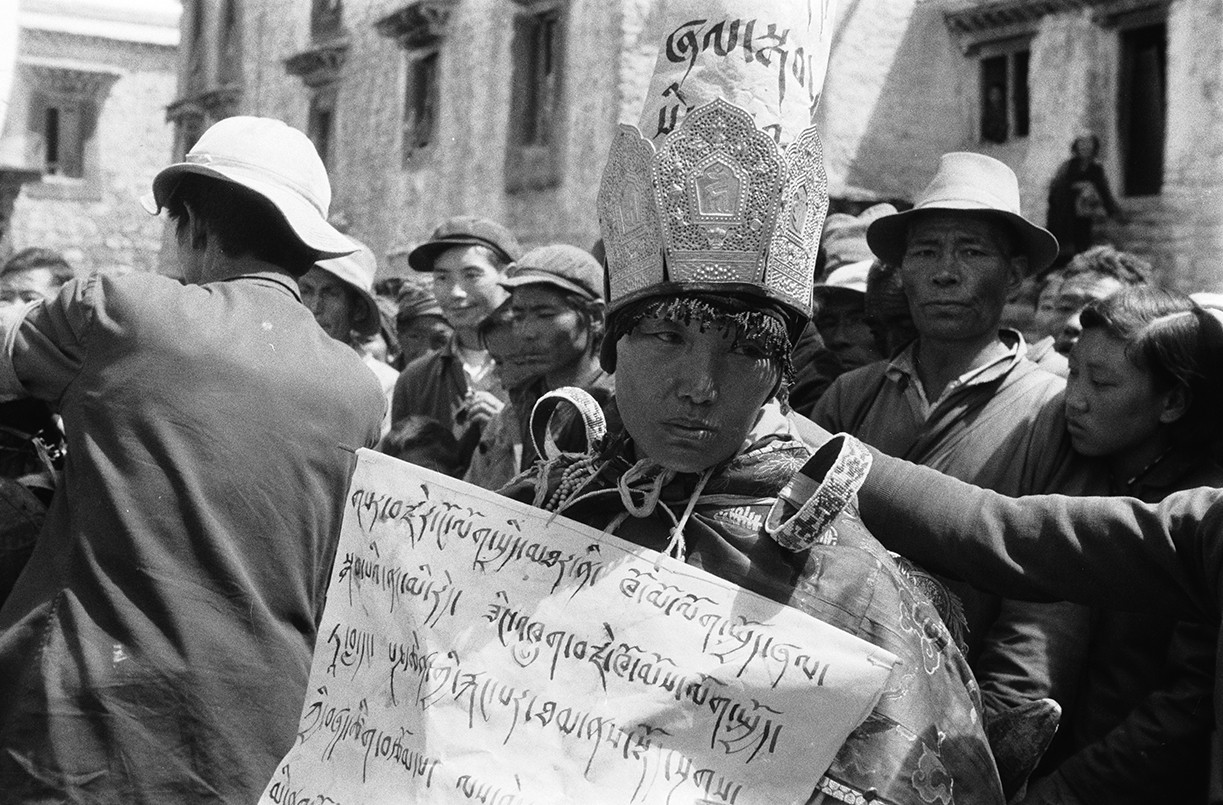
The moment we begin to discuss Tibet, we are confronted with two opposing historical narratives. In the first narrative, Tibet is a country that has been occupied by China, its culture and political autonomy suppressed. In the second narrative, however, pre-modern Tibet is a theocratic-feudal society dominated by the Dalai Lama, the great monasteries and aristocratic families, and the Chinese Revolution liberated the Tibetan working class from this system. However, it would be a grave mistake to assume that these two narratives are entirely mutually exclusive. It is possible that old Tibet was characterised by severe class inequalities; at the same time, it is also possible that the Tibetan people possessed the right to determine their own political future. Indeed, from a Marxist perspective, the crux of the matter lies precisely here. For a people’s right to self-determination is not a reward granted because that people had previously established a democratic, secular or socialist society. It is a political right. Criticising Tibet’s former social structure is one thing; deeming it legitimate for Beijing to decide Tibet’s future is quite another. The moment we confuse these two, we end up conflating class struggle with state sovereignty, socialism with the interests of the central state, and internationalism with the politics of a great power.
To speak of Tibet’s freedom, we are not obliged to portray old Tibet as a Buddhist paradise; on the contrary, we must not do so. The work of the historian Melvyn Goldstein on traditional Tibetan society shows that it was an extremely hierarchical society. Goldstein demonstrates that the vast majority of the lay population were bound by hereditary relationships of dependency to aristocratic or monastic estates; yet he also highlights that there was a certain degree of social mobility within this system. Although there is debate amongst historians as to how this structure should be labelled, there is a solid historical basis for the view that ancient Tibet was not an egalitarian society. Consequently, there is no reason to reject socialist criticism of the ancient Tibetan order. The Dalai Lama’s religious and political authority may be criticised; aristocratic privileges may be criticised; the economic power of the major monasteries may be criticised; relationships of dependence on the land and the lord may be criticised; and the tax and labour obligations imposed on the peasantry may be criticised. It is, of course, inconceivable for a Marxist to defend these things.
However, this leads to an entirely different conclusion: ‘Old Tibet was reactionary; therefore, China’s establishment of sovereignty over Tibet was historically progressive.’ This is the proposition that must be debated. For the moment we accept this logic, the backwardness of a society becomes the source of legitimacy for another state’s intervention in that society. This cannot be applied solely to Tibet. The same logic can be applied throughout the entire history of colonialism. Colonial states also built roads, laid railways, established centralised administrations, eliminated local aristocracies in some places, and opened modern educational institutions. But Marxism does not judge colonialism by the number of kilometres of railway built. The fundamental question is this: Is a people the subject of its own social transformation, or does another state claim the authority to make decisions on that people’s behalf?
This is the crux of the Tibetan issue. Why must the liberation of the Tibetan peasant from the aristocracy necessarily be the same as Tibet’s political subordination to Beijing? Why should the liberation of the Tibetan worker from the monastic aristocracy mean relinquishing their own political will? Class liberation and national liberation are not mutually exclusive. A people can simultaneously oppose both their own ruling class and an external power that decides their fate on their behalf. From a Marxist perspective, the revolutionary subject is the people themselves; it is not the army of another state. Therefore, the correct question is not ‘Was old Tibet progressive?’. The correct question is: Does the Tibetan people have the right to be the subject of their own social and political future?
Here, we must also avoid another oversimplification regarding China. It is incorrect to assess today’s China under the same social system as that of the 1949 Chinese Revolution, as if no changes had taken place. The Chinese Revolution was a historical turning point. Particularly from the mid-1950s onwards, the scope of private capital was significantly curtailed, large industrial enterprises were nationalised, banking and foreign trade were centralised, agriculture was collectivised, and the economy was integrated into a system of central planning. The political system of the Mao era, the role of the bureaucracy and the limits of workers’ democracy are open to criticism. However, it is clear that the fundamental economic orientation of the period was not the expansion of private capital, but the restriction and elimination of capitalist property relations. After 1978, however, a different historical process began. Market mechanisms expanded, private capital once again became a major economic force, foreign capital flowed into the Chinese economy in large quantities, and profit, competition and capital accumulation became increasingly decisive factors in economic life. To explain today’s China as a mere continuation of the economic relations of the Mao era would be to ignore this transformation.
One of the strongest arguments for claiming that today’s China is socialist is the size of the state sector. Indeed, the Chinese state is extremely powerful in strategic sectors of the economy. However, from a Marxist perspective, state ownership is not the same as socialism. The fact that a factory is state-owned rather than privately owned by a capitalist represents a significant change in ownership. However, it does not automatically follow that the factory is now under the democratic control of the workers. Marxist analysis must look not at title deeds, but at social relations. Who makes the decisions on production? Who appoints the managers of the enterprise? Who decides how the surplus product is to be used? Can workers elect and dismiss their managers? Can workers establish independent class organisations? Is the aim of production to meet social needs, or is it to ensure the enterprise’s competitive strength, growth and capital accumulation? These questions determine whether state ownership is socialist or not. State ownership can be a means of socialist transformation. However, state ownership in itself is not socialism.
It is particularly instructive to examine the Chinese state’s own documents in this regard. On the one hand, the Chinese Constitution defines public ownership as the foundation of the socialist economic system and states that the state sector plays a leading role in the economy. However, the same constitution also explicitly acknowledges that various forms of ownership develop alongside public ownership. More importantly, it defines private enterprises as ‘an important component of the socialist market economy’. It specifies that the rights of the private economic sector will be protected by the state and that their development will be encouraged. The same constitution also safeguards legal private property and the right to inheritance. This is no mere detail. For the issue is not simply a matter of a few small traders operating on the fringes of the socialist economy. Private capital is one of the legally recognised components of the current economic order. The Law on the Promotion of the Private Economy, adopted in 2025, has made this even clearer. The aim of the Act is to improve the environment for the development of the private economy, to ensure equal competition for private economic entities in the market, to support investment and financing, and to strengthen the role of the private economy in national development.
The Marxist question is therefore inevitable: If private capital exists, it can employ wage labour, accumulate capital, generate profit, private property can be bequeathed, and the growth of this capital is legally encouraged by the state; by what material criterion can we claim that capitalist social relations have been abolished? The Chinese state’s response to this is the theory of the ‘first stage of socialism’ and ‘socialism with Chinese characteristics’. This is the political and theoretical thesis of the Chinese Communist Party. However, the task of Marxist criticism is not to repeat the name a state gives itself; it is to examine the relations of production.
An even more fundamental question is this: is the working class truly in power in China? A party defining itself as the representative of the working class is not the same as the working class actually being in power. If we say that a class is in power, we must be able to demonstrate the material forms of this. Where is the workers’ actual control over production? Where is the workers’ capacity for independent political organisation? Where is the mechanism within enterprises for electing and recalling managers from below? Where is the working class’s direct decision-making mechanism regarding how the economic surplus is to be used? Class power in the Marxist sense cannot be demonstrated by the existence of a state apparatus acting ‘on behalf of the people’. For representation is not the same as sovereignty. A state may claim to be governed on behalf of the workers. However, this does not imply that the workers actually govern the state. Consequently, the following question must lie at the heart of any discussion regarding present-day China: Does the state control capital, or does the working class genuinely control the production process and the state? These are two entirely different matters.
However, we are now coming to a far more important point. Let us suppose that all the above criticisms are wrong. Let us suppose that today’s China is accepted as a fully socialist society. In that case, does the Tibetan people’s right to self-determination cease to exist? According to the Leninist theory of the national question, the answer is still no. This is because the right of nations to self-determination is not merely a temporary right granted to peoples living under the domination of capitalist states. Lenin explicitly linked self-determination to a nation’s right to separate politically from another national-political structure and to establish an independent state. More importantly, he argued that socialists must defend voluntary ties, not compulsory ones. He did not argue that every nation must necessarily secede; however, he insisted on the recognition of a nation’s right to secede. This distinction is of the utmost importance: defending the right to secession is not the same as defending secession in every circumstance. True unity can only be voluntary where the freedom to secede exists. If a people are presented solely with the option of ‘you can remain united’, it becomes difficult to speak of self-determination in that context.
When we strip the Tibet debate of all its layers of propaganda, what remains is an extremely simple yet fundamental question: who should decide Tibet’s future? Beijing? Washington? Delhi? The Dalai Lama? Another state? Or the Tibetan people themselves? From the perspective of the Leninist principle of self-determination, the answer is not to select a specific final status from outside. It could be independence, a federal structure, broad political autonomy, remaining within China, or some other political arrangement. The moment an external decision is made as to which of these is correct, the very principle of self-determination ceases to exist. The essence of the principle is this: the Tibetan people must be able to freely discuss all political options, including independence, and determine their own future without coercion. This idea is not found solely in Leninist theory. The United Nations General Assembly’s Resolution 1723 on Tibet, dated 20 December 1961, also explicitly referred to the Tibetan people’s right to self-determination. This resolution was not a binding declaration of independence that resolved Tibet’s legal status on its own; however, it is an important historical document showing that the issue of self-determination regarding Tibet was explicitly raised at the international level.
Let us now return to the initial discussion. Old Tibet was reactionary. There were vast class inequalities. There was an aristocracy. There was a religious hierarchy. Vast sections of the peasantry were caught up in relations of dependency. To state these facts is not to be against the Tibetan people; on the contrary, it is to be honest with history. However, with precisely the same honesty, we must ask the following question: Does the fact that a people were poorly governed in the past deprive them of the right to determine their own future? If the answer is yes, then very few peoples in the world would be entitled to self-determination. For which society in history has been free from exploitation? Which people’s past has been free of aristocracy, class oppression, religious domination or despotism? Linking rights to the nature of past regimes amounts to holding peoples accountable for the crimes of their own rulers. A Marxist approach cannot accept this. The Tibetan people’s right does not stem from whether the Dalai Lama is progressive or not. The Tibetan people’s right does not stem from whether Buddhism is progressive or not. The Tibetan people’s right does not stem from the class structure of old Tibet. The right stems from the people being a political subject.
Another problem arises here from a left-wing perspective. The existence of the geopolitical struggle waged by the US against China does not mean that every criticism directed at China serves American imperialism. Similarly, the possibility that Washington might exploit the Tibetan issue for its own interests does not negate the rights of the Tibetan people. Anti-imperialism does not mean defending every policy of every state that is a rival to the United States. Such an understanding shifts socialism from the people to the states. Yet the subject of Marxist internationalism is not states, but workers and peoples. The fact that one great power stands against another does not automatically make it socialist or progressive. Similarly, the fact that a people’s demand is supported by Washington does not automatically render that demand illegitimate. The nature of a right cannot be determined by which major state seeks to instrumentalise it.
This is perhaps the most important lesson the Tibet debate has taught us. If we equate socialism with the geopolitical interests of a state, we lose sight of the essence of socialism. Socialism is not a state flag, nor is it the name of a party; it is not a revolution carried out in the past, nor is it the size of state-owned enterprises, nor the state’s capacity to regulate capital. From a Marxist perspective, socialism is the claim that producers become the true agents of their own social life. The same principle applies to the national question. The freedom of a people does not lie in another state making decisions on their behalf. Nor is it emancipation when a central state declares, ‘We are governing you for your own good’. Just as the fact that the Tibetan peasant’s master was an aristocrat in old Tibet is subject to criticism, so too must the determination of the Tibetan people’s political destiny by another central authority be questioned with the same theoretical courage. For socialism is not merely a change of masters. Liberation is the people becoming the subjects of their own lives.
When viewed from a Marxist perspective, the most consistent conclusion that can be defended regarding the Tibetan question is not to declare a single, externally determined final status for Tibet. The real issue is the right to choose. It is possible for Tibetans to choose to live within China. It is possible for them to opt for independence. It is possible for them to demand a federal or other political system. However, a genuine choice exists only when all options are truly possible. This is where the fundamental strength of Lenin’s theory of self-determination lies. The separation of a people is not compulsory; but if the right to secede does not exist, unity is not voluntary. For this reason, the fundamental Marxist question in the Tibet debate is neither the Dalai Lama, nor Buddhism, nor the ‘socialist’ label bestowed upon the Chinese state. The fundamental question is this: Will a people be the subject of their own future, or will they not? Condemning the aristocracy of old Tibet does not eliminate this question. Recognising the historical achievements of the Chinese Revolution does not eliminate this question. Acknowledging the socialist transformations of the Mao era does not eliminate this question. Nor do the economic successes of present-day China eliminate this question. For the right of peoples to self-determination is not a right to be relinquished in exchange for economic development. And the test of socialism must be measured not only by what it does to capital, but also by the extent to which it allows the peoples under its rule to have a say in their own futures.