


Franziska Stier
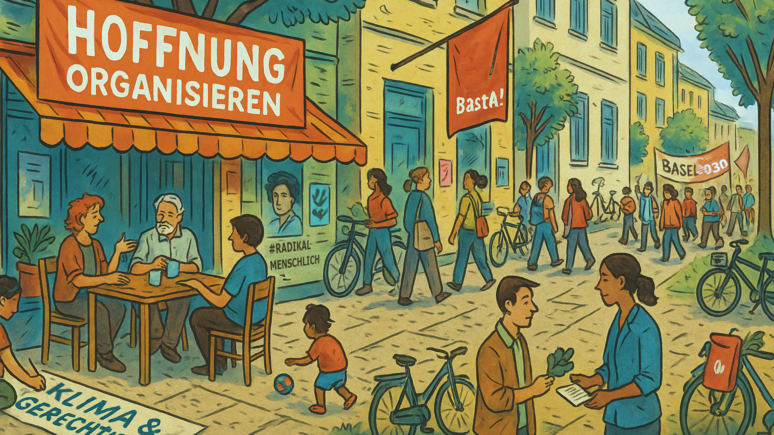
Anyone who wants to organise hope needs a political approach that brings people together. BastA! was founded as a party with the character of a social movement. The aim was to create a ‘middle ground’ between parliament and the movement, which still holds true today.
BastA! is not a party run by a select few – although it sometimes feels that way, as too much work ends up falling on too few people. Our understanding of socialism also means advocating for radical democracy, which is based on self-determination, international solidarity and people’s active involvement in shaping history. Rosa Luxemburg had already set these ideas down on paper in the Spartacus League’s programme under the title ‘What Does the Spartacus League Want?’, thereby getting on the nerves of more than a few socialist leaders: ‘The essence of socialist society lies in the fact that the great working masses cease to be a governed mass, but rather live the whole of political and economic life themselves and direct it through conscious, free self-determination.’
Pessimism of the intellect, optimism of the will
The Italian communist Antonio Gramsci, too, grappled with the question of attitude and called for a ruthless analysis of the balance of power, coupled with an unwavering belief in the possibility of change through collective action. We know from him that domination is established not only through coercion but also through hegemony – that is, culture, education and the media – and that it is the task of socialist parties to build counter-hegemony. Socialism is thus not merely a political goal, but also a cultural practice. Socialism is not merely an act of seizing power, but a protracted process of transforming society.
Organising the socialist-feminist current of warmth
It is not enough simply to be against capitalism, patriarchy and ecological exploitation. Rather, we must organise spaces in which we can shape everyday life together with others. One space where decisions are made about people’s everyday lives is parliament. Yet here, people appear merely as ‘political objects’ upon whom decisions are imposed.
Given the current balance of power, the bourgeoisie can be forced to make the odd compromise, but no major breakthroughs have been achieved. BastA! was successful where we had broad social movements behind us and where people organised themselves in neighbourhoods to resist.
These movements require time, energy and money. They do not last long, because everyday life, the standard 42-hour working week and childcare demand too much energy to remain healthily committed both simultaneously and in the long term. Yet even a short-term collective experience of fighting together changes us – be it in the feminist strike movements or in other transformative struggles such as the climate justice movement around Basel2030.
Moving forward by asking questions
The experiences of the door-to-door conversations with Basel2030 were striking. People expressed their gratitude because no one had ever taken an interest in them before. Others, however, were overwhelmed by the fact that someone was asking serious questions about their situation and their needs. More often than not, left-wingers use a question as a starting point, only to go on to deliver a detailed analysis of imperialist or, alternatively, capitalist exploitation – a 10-minute monologue for which absolutely no one has the time or interest.
But it is this genuine interest in the lives of our fellow human beings that defines us as socialists and that we must build on – without falling into the trap of lecturing.
It must never be about us governing people. Instead, change must be organised together with the people. The challenge lies in bringing about personal change and social change hand in hand. Racism, misogyny, queerphobia, anti-Semitism, povertyphobia and ableism … these are all attitudes that are deeply ingrained in our society and do not stop at the ‘revolutionary subject’. And however much we reject it, we too contribute to oppression on a daily basis. But we do not break it down by retreating exclusively into theoretical circles. Of course, a clear stance and reflection are needed here too, but I am convinced that these divisions and forms of oppression can only be overcome through a shared struggle and a genuine interest in one another – by acting together in a #radicallyhuman way.
Organising neighbourhoods – a political utopia?
Through discussions with Turkish and Kurdish partner organisations, we have learnt just how diverse party life can be. Alongside thematic groups, the parties foster a wide range of cultural and sporting activities, which bind far more people to the party than politics itself. These spaces foster exchange and understanding.
The socialist aim is to organise the shaping of life in neighbourhoods – not from above, but driven by the many, with BastA! right at the heart of it rather than merely on the sidelines. Perhaps with a tea house, a social advice centre or some other concrete focal point for the many.
Perhaps the council-based democratic structures of ‘democratic confederalism’ also offer approaches to realising this concrete utopia. The strength of Abdullah Öcalan’s ideas lies not only in his views on women’s liberation and ecology, but also in the fact that people participate in the practical implementation of their decisions through councils. Through this very concrete participation, a collective appropriation of public space takes place, which counteracts alienation and isolation.
I am convinced that BastA!, with a firm, clear and, despite everything, cheerful attitude, can contribute to a socialist society outside the context of political election cycles. Let’s get started!
Franziska Stier
, Party Secretary, BastA!
Source / First published: BastA!, Socialist Stance and Political Practice, 8 June 2025.
Original: https://basta-bs.ch/artikel/sozialistische-haltung-und-politische-praxis