


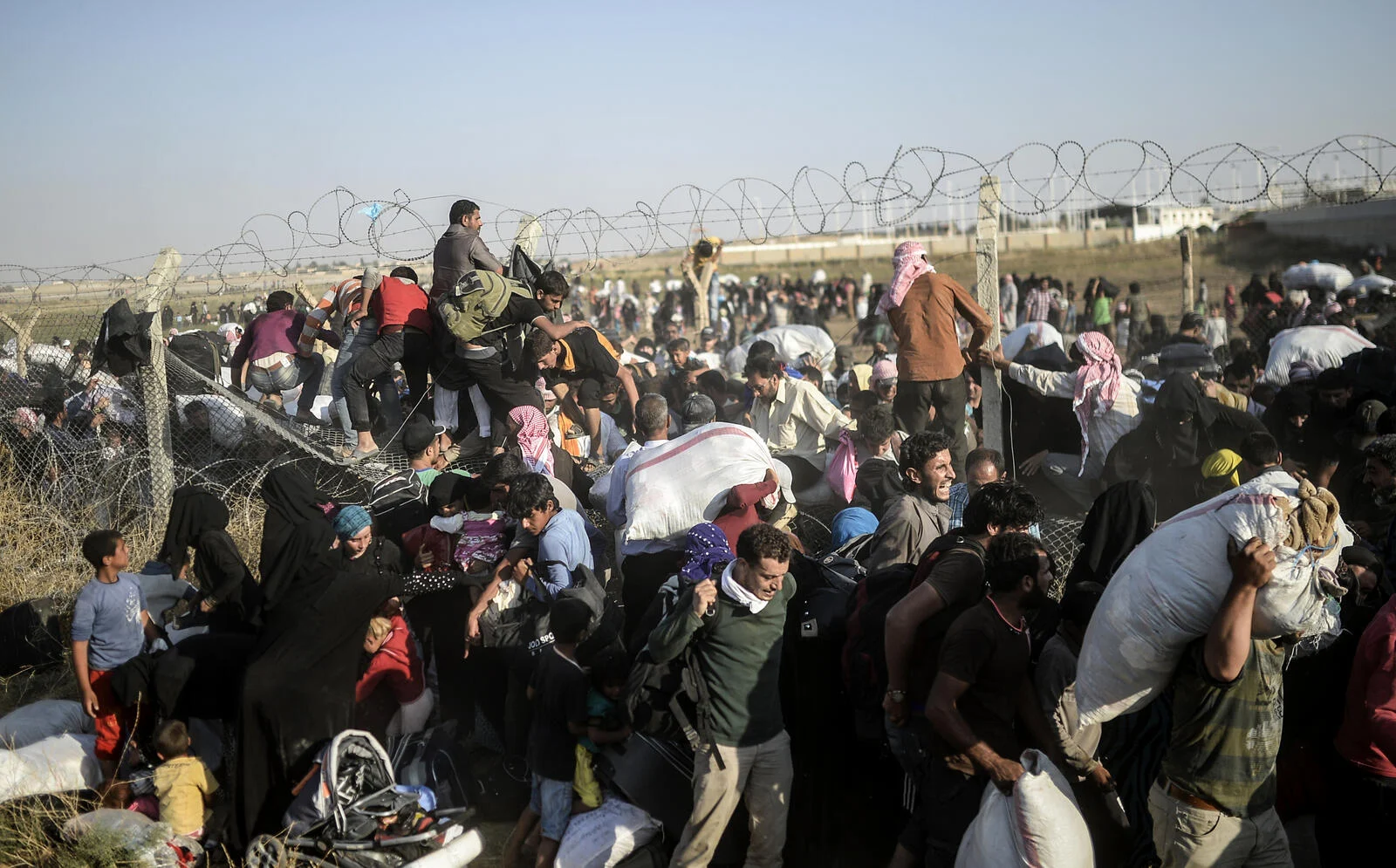
For many years, Turkey portrayed itself solely as a country from which people migrated to Europe. Today, however, it is a region that simultaneously sends people abroad, receives migrants, serves as a transit route, and sends its own citizens to other countries for economic, political and social reasons. Migration is no longer a temporary ‘problem’ for Turkey; it is one of the fundamental issues underlying the country’s class, political and social structure.
Discussions on migration in Turkey are often centred solely on the people crossing the border. Numbers, camps, deportation centres, debates on citizenship and slogans that resurface during election campaigns… Yet reducing migration solely to the question of ‘who has arrived?’ renders the real issue invisible. For migration is not merely a movement across borders. Migration is the result of war, poverty, unemployment, oppression, inequality, forced displacement and the loss of a future.
Turkey’s history of migration is replete with clear examples of this.
From the 1960s onwards, hundreds of thousands of people went to European countries, primarily Germany, as workers. In those years, Turkey was a country that exported its labour force. People turned to other countries in search of better pay, a more secure future and the chance to support their families. Over time, this migration became permanent; families were reunited, second and third generations were born, and a significant population of Turkish origin emerged within Europe’s economic and social fabric.
However, emigration from Turkey was never driven solely by economic reasons.
Following the military coup of 12 September 1980, thousands of people were forced to leave the country for political reasons. Left-wing activists, trade unionists, journalists, students, Kurdish politicians and various opposition groups sought refuge in Europe. In subsequent periods, political repression, conflict and human rights violations gave rise to new waves of exile.
In the 1990s, the forced evacuation of villages and armed conflict in the Kurdish provinces constituted one of the largest internal migration movements in Turkey’s recent history. Hundreds of thousands of people were driven from their villages and regions to major cities. Istanbul, Mersin, Adana, Izmir, Diyarbakır and other cities bore the social consequences of this forced displacement.
These people were often not even defined as ‘migrants’, as they had not crossed the country’s borders. Yet what they experienced was one of the harshest forms of migration: the forced loss of their homes, their land, their livelihoods, their social networks and their way of life.
Today, when migration is discussed, this history is largely forgotten.
With the Syrian war, Turkey’s migration regime changed completely. Millions of Syrians arrived in Turkey. Turkey is no longer merely a country of emigration, but has become a country receiving migrants on a massive scale. Subsequently, people from Afghanistan, Iraq, Iran, and various regions of Africa and Asia attempted to reach Europe via Turkey or remained in Turkey.
Turkey thus found itself in three distinct roles simultaneously: a country of emigration, a country of immigration and a transit country.
This situation has not merely brought about a demographic shift. It has also made migrant labour a significant part of the Turkish economy.
Migrants from Syria, Afghanistan and other countries are employed on low wages in the textile, agricultural, construction, manufacturing and service sectors, as well as in the informal economy. They often work long hours without social security, in conditions that leave them vulnerable to workplace accidents.
The fundamental question here is: who is responsible for migrant workers being paid such low wages?
Is it the migrant, or is it the economic system that exploits them as an insecure and cheap labour force?
This distinction is important. Because it is all too easy to point to migrant workers as the cause of the economic crisis, unemployment and poverty. However, it is far more difficult to discuss the structural conditions that suppress wages, weaken trade union organisation, encourage informal work and drive down the cost of labour.
This is precisely where the political utility of anti-migrant sentiment comes to the fore.
When the economic crisis deepens, it is possible to direct society’s anger downwards rather than upwards. If rents are rising, migrants are blamed. If unemployment is rising, migrants are blamed. If wages are falling, migrants are blamed. If public services are inadequate, migrants are once again singled out.
In this way, the most vulnerable sections of society are pitted against one another.
Whilst the impoverished Turkish citizen and the impoverished Syrian worker are pitted against one another, the economic system that condemns both to precariousness is left out of the debate.
Anti-migrant sentiment is therefore not merely a matter of prejudice. It also serves a class-based function.
It intensifies competition amongst workers, prevents the formation of common demands and makes it harder for labour to organise. Whilst the local worker is told ‘a migrant has taken your job’, the migrant worker is given the message ‘if you speak out, you’ll be deported’.
Ultimately, the winner is capital, which can employ workers for lower wages and with fewer rights.
Another important dimension of the migration debate in Turkey is the relationship with the European Union.
For many years, Europe has been attempting to extend its borders beyond its own territory. Turkey has become one of the key centres of this policy. Agreements with the European Union have led to Turkey being positioned as a buffer state that keeps migrants outside Europe’s borders.
Consequently, the movement of people between Turkey and Europe has increasingly become a matter of negotiation.
Migrants are no longer seen merely as people in need of protection, but are increasingly viewed as tools in diplomatic negotiations between states.
On the one hand, Europe says, ‘Protect our borders’. On the other, Turkey occasionally uses migrants as a tool for political pressure.
In this equation, however, it is the migrants themselves who have the least say.
They are often unable to decide for themselves whether they will be allowed to cross into Europe, under what conditions they will live in Turkey, or whether they will be sent back.
As migration policy transforms into security policy, the human being becomes invisible.
Borders are being fortified, walls are being extended, deportation centres are multiplying, and detentions and deportations are on the rise.
Yet nobody is asking this question often enough:
Why did these people set out on their journey?
Why would a person leave behind the country where they were born, their family, their friends, their language and all their habits?
Most people do not choose to migrate as an adventure. Migration is often the result of dwindling alternatives.
If there is war, people flee.
If there is political oppression, people flee.
If they cannot find work, if they cannot see a future for their children, if they cannot pay off their debts, if they face the risk of imprisonment for their beliefs, if they cannot escape violence because they are women, or if they face oppression because of their identity, people seek the possibility of a life elsewhere.
This does not apply solely to those coming to Turkey.
Today, a large number of young people from Turkey are also looking for ways to go abroad.
Doctors, engineers, academics, students, artists, IT professionals and people from various other professions are trying to build a life in other countries.
It is also insufficient to explain this migration solely through the concept of ‘brain drain’.
Because the issue is not merely about higher salaries.
People are seeking legal safeguards, freedom of expression, working conditions, education, quality of life and a sense of the future.
If a significant proportion of a country’s young people have begun to see their future in other countries, migration ceases to be merely an individual choice. It becomes a social indicator.
Turkey is currently at precisely this juncture.
On the one hand, migrants arriving in the country are asked, ‘Why are you here?’
On the other hand, millions of Turkish citizens are searching for the answer to the question: ‘How do I leave this place?’
This contradiction is perhaps the most striking aspect of the migration debate in Turkey.
It is easy to blame people coming to Turkey without assessing the economic and political conditions in their own countries. However, a society that fails to question why its own young people wish to go to Germany, Switzerland, the Netherlands, Canada or other countries is rife with inconsistency.
If we truly wish to understand the issue of migration, we must ask not only ‘who has come?’ but also ‘who is leaving and why?’
Similarly, we cannot ignore the gender dimension of migration.
Migrant women face multi-layered inequalities stemming both from being migrants and from being women. Issues such as exploitation in the informal sector, domestic labour, violence, human trafficking, access to healthcare and childcare must be addressed at the heart of migration policy.
A similar situation applies to children.
Issues such as migrant children’s access to education, language barriers, child labour and discrimination cannot simply be brushed aside under the heading of ‘integration’.
A child’s right to education, healthcare and safety should not be determined by the passport they hold.
The measure of migration policy should not be how strictly the border is guarded, but how well human life and dignity are protected.
In Turkey, however, migrants are increasingly becoming one of the key tools of electoral politics.
Political parties are attempting to win votes by exploiting the issue of migrants.
Whilst one side tightens its deportation policies, the other responds with even harsher promises.
Thus, human life is being turned into a pawn in political competition.
Migrants themselves, however, are often unable to have a say in this debate.
Everyone talks about them, but very few people ask what they think, what they are going through, why they have come, or what they want.
At GOCCOM, we believe that this is precisely where a different approach is needed.
It is possible to discuss migration without romanticising it, without ignoring its problems, and without turning migrants into scapegoats.
Border policies can be debated.
Migration management can be debated.
The capacity of public services can be discussed.
Employment, housing and education policies can be debated.
However, the answer to none of these can be racism, hatred or collective punishment.
A policy that devalues people on the basis of their nationality does not solve any social problem.
On the contrary, it creates new inequalities and new conflicts.
What Turkey needs is not a harsher tone towards migrants, but a more serious political programme to tackle the root causes of migration.
Migration cannot be halted without addressing war policies.
Economic migration cannot be reduced without tackling poverty and inequality.
Political migration cannot be prevented without strengthening democracy and the rule of law.
People will continue to leave countries where they see no future.
This reality applies to Turkey as well.
Some of those living in Turkey today have come here from other countries.
Meanwhile, a significant proportion of those born in Turkey are considering moving to another country.
It is impossible to consider the stories of these two groups as entirely separate from one another.
Both are people moving in different directions within the same global order.
One is fleeing war.
The other from unemployment.
One is fleeing political oppression.
The other from a lack of prospects.
One is crossing the border into Turkey.
The other is queuing for a visa in order to leave Turkey.
That is why we must place people at the heart of the migration issue.
Migrants are not the cause of this system.
More often than not, they are its consequence.
It is easy to pit against one another the people who pay the price for war, poverty, oppression, unemployment and inequality.
What is difficult is to question the system that drives them to flee.
What Turkey needs in relation to the migration issue is not more fear, hatred and hostility; it is a new political discourse centred on rights, equality, solidarity and human dignity.
For there is not as great a distance as one might think between the person regarded as a ‘foreigner’ on this side of the border today and the Turkish citizen waiting as a ‘foreigner’ at another country’s border tomorrow.
Both share the same fundamental demand:
A safe, free life that respects human dignity.
GOCCOM Turkey